









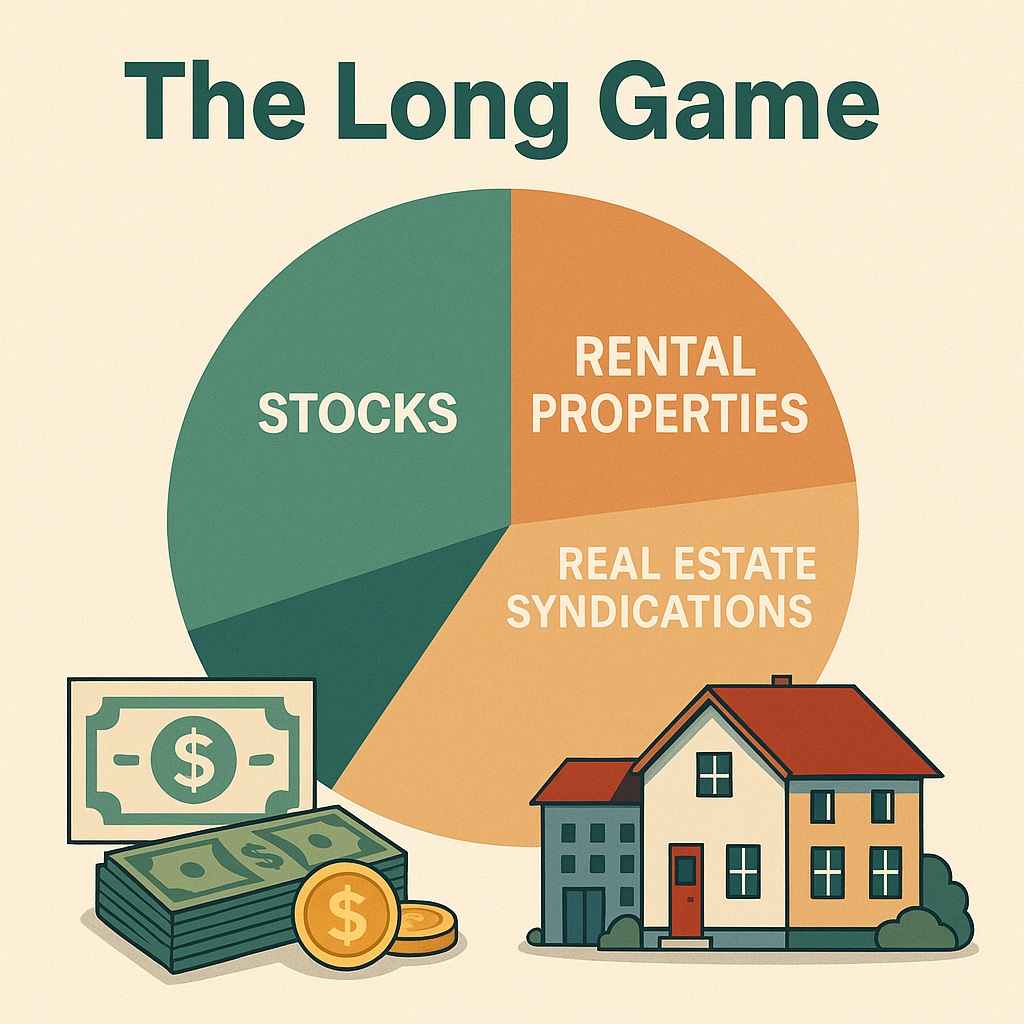
When it comes to investing, I like to keep things balanced. I don’t believe in putting everything into one basket, whether it’s stocks, real estate, or something trendier like crypto. Instead, I’ve built a mix of assets that each serve a purpose. Stocks (through ETFs) give me exposure to broad economic growth, cash equivalents provide security and flexibility, rental properties create income and appreciation that I can directly influence, and real estate syndications add diversification, scale, and tax benefits.
I don’t spend much time worrying about when to sell. My focus is on building assets over time and maximizing their potential, not timing exits.
📈 Stocks (Through ETFs): Broad Diversification Without Market Timing
I don’t spend time chasing the next hot stock or trying to time the market. History shows that even professional money managers rarely succeed at consistently calling tops and bottoms. Instead, I focus on time in the market, not timing the market.
For me, that means using exchange-traded funds (ETFs) to build broad diversification. ETFs give me access to entire markets—hundreds or even thousands of companies—with a single investment. By steadily investing over time, I’m able to capture the long-term growth of the economy without worrying about short-term volatility.
💵 Cash Equivalents: Just Enough to Sleep Well at Night
There are plenty of schools of thought on how much cash to hold. Some recommend three to six months of living expenses, others say a full year, while some investors believe in keeping nearly everything invested and relying on credit or asset sales in an emergency.
I don’t follow any particular formula. I simply keep enough cash on hand to feel comfortable. It’s not about maximizing returns—cash won’t make me wealthy—but it provides flexibility and helps me sleep well at night knowing I can handle short-term needs or jump on opportunities when they arise.
🏡 Rental Properties: Income, Appreciation, Control—and Tax Benefits
Real estate has been one of my favorite asset classes because it delivers multiple benefits at once: consistent rental income, long-term appreciation, and the ability to directly influence performance through management.
Another huge advantage is the tax benefits. Depreciation allows me to offset a portion of the rental income, reducing my taxable income without affecting cash flow. This makes real estate even more attractive compared to other assets that don’t offer the same level of tax efficiency.
🤝 Real Estate Syndications: Scale, Diversification, and Depreciation
Syndications take the benefits of real estate even further. By pooling resources with other investors, I can participate in larger projects like apartment communities, industrial properties, or self-storage facilities—assets I couldn’t access on my own.
Syndications offer me the potential for higher returns and steady cash flow, and they provide diversification across regions and property types. On top of that, they also deliver depreciation benefits, which help offset the income distributions I receive. It’s one of the rare investments that combines attractive returns with tax advantages.
That said, syndications are also the category where I have the least control. Unlike rental properties, where I can make direct decisions, I’m relying on the sponsor—the group managing the deal—to execute the business plan effectively. If they do it well, syndications can be my highest-returning investments, but they require trust in the sponsor’s expertise and management.
📊 How Assets Perform in Different Market Conditions
One of the main reasons I diversify is because assets perform differently depending on what’s happening in the economy:
-
Stocks: Thrive in strong economic growth but can drop sharply in recessions. Over time, though, they’ve historically delivered some of the highest returns.
-
Cash Equivalents: Provide stability in downturns. They don’t grow much, but they protect purchasing power and give me the flexibility to act when markets dip.
-
Rental Properties: Often hold up well during inflationary periods since rents tend to rise with the cost of living. Even in slower markets, they still provide steady income.
-
Syndications: Performance depends on the type of property and region. They can be a hedge against stock market volatility, offering cash flow even when equities struggle.
Because no single asset is bullet-proof, holding a mix means I don’t have to guess which market condition is coming next. Whatever the cycle, I know at least part of my portfolio is positioned to do well.
🔄 My Focus: Growing, Not Selling
For me, the goal isn’t figuring out when to sell—it’s finding ways to keep growing what I already own. That means being intentional about how capital is managed and reinvested:
-
Rebalancing: Adjusting allocations so my overall strategy stays aligned with my goals.
-
Refinancing: Leveraging lower interest rates or built-up equity in real estate to free up capital without losing ownership.
-
Redeploying Capital: Putting money back to work instead of letting it sit idle. That includes profits from rental income, dividends, interest, and syndication sale proceeds—all of which can be reinvested into new opportunities with strong potential for growth or income.
This mindset helps me steadily compound wealth, keeping my capital productive rather than sitting on the sidelines.
🕰️ The Long Game
My investing strategy isn’t about finding the perfect moment to buy or sell. It’s about steadily building assets, keeping them working, and letting time and compounding do the heavy lifting. By blending ETFs, cash, rental properties, and syndications, I create a portfolio that generates growth, income, and stability—while also giving me flexibility and tax advantages along the way.
For those who want to explore the syndication side, we created the Rentals America Passive Investment Club. It’s a simple way to invest in larger projects alongside us—without the day-to-day management—while benefiting from income, diversification, and tax savings.
